On Japan

Japan, my country

I wanted to visit Japan since I was a kid, I finally got the chance as a grown up, I planned my trip… for 2020. COVID19 happened.

I finally managed to travel in 2025, and it felt a bit like going home.

Places and architecture were familiar. Behaviours seemed natural. Signage made sense. Food I’d never tasted was clearly recognizable and appetizing.

It turned out, I had been living in Japan for a long time. Consuming inordinate amounts of foreign pop culture has an effect on you. And I’ve consumed a lot of Japanese content, for a long time.

An Italian childhood

I grew up in Italy in the ’80s, when Japan had become the strongest economy in the world, and Italy was becoming more economically liberal.

We saw Japan becoming dominant first hand through TV. So called “private” TV channels (in contrast to the public broadcasting of RAI) were booming§, and very often they used Japanese shows to fill their programming.

All the kids of my generation grew up watching anime such as Captain Tsubasa, Lupin The Third and many more. We also got some live action such as Godzilla, Megaloman, Ultraman etc.. I suppose TVs bought TOHO stock in bulk. I can’t forget the Megaloman fighting scenes, and his hair-on-fire-attack, which was translated in italian as something like “flame of megalopolis” (see here). There were even anime/tokusatsu hybrids such as the awesome Kyouryuu Daisensou Aizenborg.

Ironically, “cartoni animati” in Italy were mostly identified with western children animation, which does not really translate to Japanese anime 1:1. This meant we got ultra-violent stuff on afternoon programming such as Fist of the North Star. Parents complained, kids loved it.

We also got TV shows (Takeshi’s Castle and Za Gaman), with italian commentary. It was deeply funny.

So, it’s only natural that, when I finally got to the country of the rising sun, it felt familiar. The two-story houses, the trains, the school kids in their uniforms, the monks and mikos, the takoyaki vendors and the ramen bars. Just like I remembered it.

A tourist country

Truth is, Dear Reader, I didn’t have a chance to see the real country. I spent a couple weeks going around popular destinations, and I got exposed to what may effectively be the Disneyland version of Japan.

I am not one to decry the fact that tourists visit popular spots. There’s a reason they’re popular. I’ve lived near Rome all my life, I know how it goes.

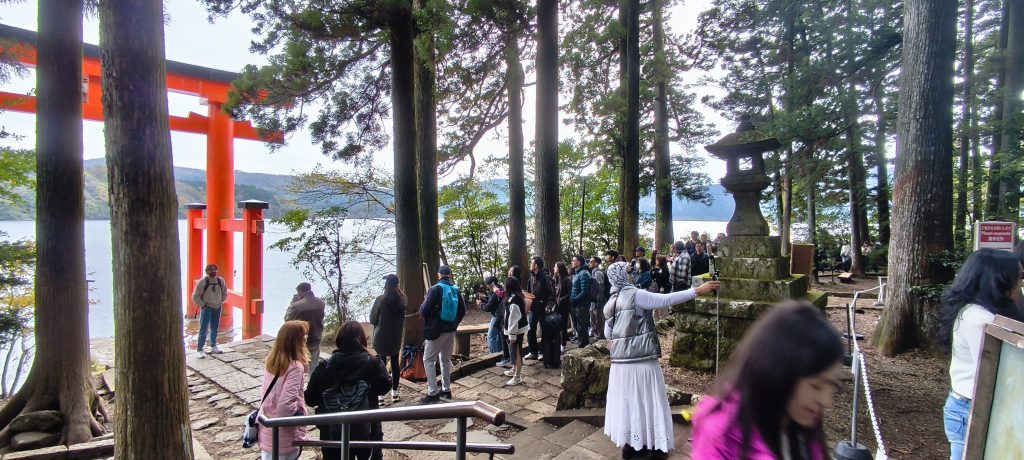
people queuing up to take an insta-worthy picture
queuing up to take an insta-worthy picture.

So I don’t mind the touristified version of the sights. But I am aware that it does not reflect the reality of the country outside of those places.

What I found interesting, as a European, is that you get less of a feeling of overtourism due to the presence of many asian tourists. You’re walking around, and thinking “look at that cute couple dressed in kimonos” and it takes a while to realize those are Korean tourists who’re just taking pictures in cool foreign clothes.

It is my understanding that Japan is overrun with tourists, and locals are annoyed by them. I’m not sure there’s a “solution” to mass tourism. I can point out there’s at least one initiative to educate tourists and locals to interact in a positive way.

I’ve gone trough it, and I thought it was pretty obvious stuff. Then I was on a bus where a bunch of tourists (germans, americans, koreans) did not leave a seat to an old lady with a small kid, and it made me realize it wasn’t that obvious.

Try not to be a dick, at home or abroad.

Off the main path, just a little

To be fair, it’s not that difficult to move away from the main tourist crowds. You may have noticed this before, Wise Reader, but quick trips have a problem of prioritization. If you spend one day in Rome, you will go see the Colosseum and St Peter’s Basilica. If you spend three days you may see Saint Paul Outside the Walls. Only if you spend many days, you will have a chance to visit the Palazzo della Civiltà Italiana, even tho it’s one of the most interesting artifact of rationalist/fascist architecture, and a pretty unique sight.

This is the same in Japan, in my experience. Some people plan to spend 3 days in Tokyo, and that’s barely enough to get off the plane. If you spend a week, you’ll be visiting many places where there’s not that many tourists.

This also works if you get away from the crowd time-wise. I visited a couple temples at sunrise, when the monks do their morning rituals, and the streets are almost empty, and it was a pretty nice experience.

Variety

If you think about it, it’s pretty obvious that Japan is a very varied country.

one floor to 40 floors, in a single block.
One floor to 40 floors, in a single block.

In a short walk you can go from buddhist temples to pachinko parlors, from shopping malls to old micro shops ran by old ladies . Heck, I found a shrine in an underpass. Small houses, skyscrapers, and everything in-between.

Even the people appear to be… weird? I mean, not weird in the sense that they are not like Europeans, they seem to genuinely have a bunch of overlapping subcultures.

Maybe it comes from living in megalopolis like Tokyo? It’s hard to be a rockabilly dancer when everyone around you is a metal head or a b-boy. But if you know you can find your kind of people then you become free(-er?) to be whatever you want. The urbanization offsets the social pressure: on the Tokyo metro, nobody knows your mom.

And talking of moms: one of the things that really surprised me about Japan was the amount of kids going around. Given the messed up demographics of the country, one would expect to see few small kids. But there’s a ton of them! I believe this is mainly caused by kids going to school alone, which is cool.

I also saw something really odd a couple times, a bunch of babies and toddlers carried around in a small cart by women§. I suppose this is some kind of home-nursery delivery system for busy parents, which is kind of cool. Again, Japan is weird, and varied.

In the year 2000 since the 1980

This hodge-podgeity naturally extends to technology. Japan was insanely advanced in the ’80s, what with their fast trains and their computerized things. And they’re still there. What seems to be missing, is that the rest of the world has moved on, and Japan hardly did. This means you still have futuristic trains, and you can use a single contact card to get on public transport everywhere… but you need to pay with cash, cause the machines won’t take a payment card.

Many things in Japan seem to have reached some kind of weird local maximum, often based on the incredible dedication of the average worker. Why automate paying with a credit card, when people can queue up to top up their cards with cash? I suspect this is the reason things like shisa kanko are a thing.

Japan is a country of strong traditions and identity, and, no pun intended, it has in many ways an insular culture.

The country was practically isolated§ from the west for centuries, until the so-called Meiji restoration/revolution happened. The country was opened up and modernized practically by force.

Perhaps mass tourism will represent a new form of forced opening. The hope is that, as the culture survived the 150 years after the Meiji restoration, it will survive the next 150. It would be sad if we lost it.

Family & Future

My kids were, somehow, natural born weeaboo, even tho I seldom consume Japan content near them. The young ones claims that Japan is his favourite country, and the older one bought a “drawing kawaii characters” book last year. By sheer chance, they go to a school where they can learn Japanese as an optional class. This is the weirdest kind of epigenetics I have ever seen.

So my hope is to go back in a few years time, with them perhaps. They’ll be more in sync with modern Japanese culture than I can ever be, cause the future is a different country, much further away than a continent. It will be interesting to be there.

I have more things to say, but I also have things to say about a bunch of other things, and this is getting long enough. I’ll have another article on Japan later, perhaps. Hopefully, before my next trip.

Micro Review: Money for Nothing by Thomas Levenson

I listened to this last summer, but it took me a long time to write something so here it is: the book talks about the first great financial crisis, the South Sea bubble.

The actual full title is “Money for Nothing: The Scientists, Fraudsters, and Corrupt Politicians Who Reinvented Money, Panicked a Nation, and Made the World Rich” which is an appropriately verbose title to talk about the early 18th century.

The South Sea bubble is one of those things that often come up when talking of the issues of the financial system, together with tulip mania and John Law’s bankrupting of France, but I had never actually understood what happened there.

The book explains that, and it does it in a fairly enjoyable way, without being too preachy and showing how disastrous events came about following a lot of reasonable choices and only a modicum of dishonesty. It also explains how innovations from the era have become staples of our modern world (e.g. ideas on how to compute the value of financial investments).

Where the book fails, imo, is trying to connect the events with contemporary developments in science and mathematics. There are connection (Isaac Newton was Master of the Mint after all) but they seem kinda stretched.

Also, in the most important bits, I felt the explanation could have been better, I could not understand, at first, how the South Sea company could make any sense.

The South Sea company was funded as a way for the government to get rid of a bunch of previous debt obligations: the government allowed the creation of a company that could emit shares in exchange for obligations, and the government would grant the company the monopoly of the South Seas trade (notice the plural, and realize this meant slave trade).

The government would get simplified accounting as it now only owes money to the company (and at a lower rate), the company owners would make money, but why would an investor give their government-baked bonds to the company? Well, because they were forced to, but the book doesn’t really explain why they couldn’t be forced even without the company existing?

I don’t know, and it doesn’t really matter, since people were eager to do the exchange as they had very little trust in the government, and because soon the share price was skyrocketing, and stonks only go up is not a modern invention.

Anyway, the book does a pretty good job of explaining the situation before, during, and after, and if you have a casual interest in finance or economics, I recommend this book.

Vote: 7+/10, recommended if you like finance, and seeing the world burn.

Guida Galattica per gli Autostoppisti: And Another Thing

NOTA: questo è un post scritto originalmente il 18 luglio 2010, sul mio primo blog che si chiamava “PDI^” e girava su Blogsome, una piattaforma che non esiste più.

È da un bel po’ di tempo che non scrivevo, e dubito di ritornare a farlo con frequenza a breve termine, ma il bello di avere un blog è che puoi scriverci comunque quando vuoi dire qualcosa.

E ho qualcosa da dire.

Ho appena finito di leggere And Another Thing che altro non è che il sesto libro della trilogia della guida galattica.

Solo che nel frattempo Douglas Adams è passato nella prossima vita, per cui il libro non è stato scritto da lui ma da Eoin Colfer, non m’è ben chiaro il perché.

Ora, io ho letto un certo numero di n-logie, in cui gli ultimi capitoli sono stati scritti da altri che l’autore originale, per capitalizzare brutalmente sui fan. Alcuni casi, come la pubblicazione di tutta la roba post-tolkieniana sono tollerabili.
Altri, come la conclusione di Dune, un po’ meno.

Per cui, quando ho scoperto che esisteva un seguito della guida galattica (che finisce con, beh, finisce che non può esserci un seguito) sono partito da un discreto livello di scetticismo.

Eppure, il libro è molto più piacevolo di quel che mi aspettassi.

Genesi di questo blog
Caro Lettore, prima di andare avanti dobbiamo chiarire una cosa: mai notato il titolo di questo blog?
PDI^2 sta per “Propulsione D’Improbabilità Infinita”.
Io non sono bravo a ricordare le cose, e non potrò mai essere un vero fan che recita a memoria i personaggi dei libri o film che ama. Però li amo lo stesso.

La guida galattica per l’autostoppista è non solo uno dei miei libri preferiti.
Nella mia lista di libri senza cui non sarei la persona che sono, è praticamente l’unico che non avrei potuto sostituire con nient’altro.
La Guida è in un sacco di modi il modo in cui avrei voluto vivere.

Quella gioia che c’è in ogni paragrafo, quel fatto che le cose vanno a puttane ogni due minuti però si va avanti comunque che sul pianeta accanto c’è qualcosa di figo e tutti da $DEITY in giù hanno cose di cui pentirsi che però vabè, capita e andiamo avanti.

I Vogon che vengono schifati dall’evoluzione, cercare qualcosa da bere mentre l’universo finisce, i topi che citano bob dylan, il pangalactic gurgle blaster, il robot depresso e le porte che godono ad essere aperte. Non c’è una singola cosa nei 5 libri che non abbia amato (tranne la bistromatic, che era un po’ fiacca).

Il che, ovviamente, ha causato la sua buona parte di problemi per una quindicina d’anni quando la mia risposta di default a ogni domanda è stata “quarantadue”.

Insomma, “And Another Thing” dovevo leggerlo anche a costo di lanciarlo contro la parete dalla rabbia.

E invece, non è stato così.

Scusate per il disturbo

Ritrovare Arthur, Ford, Zaphod e Trillian è stato come rivedere amici che hai perso di vista ma con cui hai fatto un sacco di cose da ragazzino. Certo, non è la stessa cosa ma fondamentalmente rimane un filo che vi unisce.

Ed Eoin Colfer, che io conoscevo solo per i libri per ragazzi della serie di Artemis Fowl (non capolavori, ma godibili) s’è guadagnato rispetto. Secondo me, nel libro si vede che è stato scritto da un altro appassionato. Certo, ci sono un po’ di ammodernamenti di contesto che stonano forse un po’, ma son pure passati trent’anni, e adesso ci troviamo con una versione quasi concreta della guida galattica, anche se gli manca il “don’t panic” e un bel po’ di ironia.

Colfer non è Adams, e la genialità di alcuni pezzi della Guida manca (vaso di petunie anyone?) ma non è un misero pastiche, né una fanfic infima.
Quando l’autore va a ripescare Thor, personaggio che poteva essere completamente dimenticato nel tourbillon di apparizioni dei cinque libri non sembra essere mancanza di idee, ma genuino lavoro nel ricollegare pezzi apparentemente scollegati, cosa che rendeva la guida così deliziosamente “comprensiva”.

Ed il titolo stesso è una perla, essendo una citazione da “So Long, and Thanks for all the Fish”

The storm had now definitely abated, and what thunder there was now grumbled over more distant hills, like a man saying “And another thing…” twenty minutes after admitting he’s lost the argument.

Se c’è una differenza, ma può darsi me la sia inventata io condizionato come sono da informazioni extra-libro, è che la guida era, chiaramente, british. Questo è, decisamente, irish.
Colfer è irlandese, e così è uno dei personaggi nuovi nel libro.
C’è un pianeta, e un continente, che si chiamano Cong, e Innisfree.
E mentre la guida aveva quell’aria di aplomb inglese (di un secolo fa?) di Arthur che cerca il tè in accappatoio su un’astronave, “And Another Thing” ha l’allegra barbarie degli irlandesi (moderni?) che usano parole straniere senza ragione sbagliandone lo spelling.

Il libro è spiritoso, ritmato e ben scritto. Ci sono una mezza dozzina di deus ex machina, solo che se in qualsiasi altro libro uno si sarebbe avvelenato il sangue, nella guida sono, boh, quasi necessari.

C’è anche quel pizzico di coraggio di mettere dentro personaggi/cose/eventi che nell’originale non c’erano e che non stonano, ma senza esagerare.
Inizia che non ti convince, poi pian piano ti prende e poi finisce con un finale che, si è sensato, ma forse si poteva fare di più.

Insomma, non è male, se vi capita, provate a leggerlo, senno chiedetemelo e se posso ve lo presto 🙂

Micro Review: This Immortal by Roger Zelazny

Another classic by Roger Zelazny, and another one I had in my reading list for years.

The book follows Conrad Nomikos, the titular immortal, as he wanders a future Earth which has become a shadow of her former self, with a tiny population and overrun with mutated and alien lifeforms.

Well, I say wander, but actually Conrad is accompanying some aliens tourists on a visit to Earth’s historic sight.

The book is brilliant for coming up with a novel approach to the post-apocaliptic distopia: failed Earth as a tourist destination§, and I loved the protagonist, who is at least a hundred years, but often speaks as if he’s been around for millennia. Conrad is witty, clever, and nasty in the right amount, e.g. he’s having the pyramids of Egypt torn down to basically spite the tourists.

But the story itself is kinda episodic, and while it has a satisfying ending, I didn’t feel the sense of “progression” that I enjoy in books. Also, some things just didn’t make much sense to me, perhaps I didn’t pay enough attention.

Still, the book was a joint winner (with Frank Herbert’s Dune) of the 1966 Hugo Award for Best Novel, so I think you should give it more than a chance.

Vote: 7-/10, I wish there were more stories of Conrad Nomikos

Micro Review: Lord of Light by Roger Zelazny

This book kept being mentioned to me for a decade or so, and I thought I should give it a go, as it falls into a category I think I enjoy, a sci-fi retelling of mythology or religion or classic stories.

The book takes on hinduism and buddhism, and describes a world where the Hindu gods (which are actually people) rule (unjustly) over a world where Buddhism, in the form of the protagonist Sam, is a revolutionary force (or, “accelerationist” as they are called in the book, who want technology for everyone not just the Gods).

Many of the characters and tropes of indic religions appear such as the reincarnation, karma, plenty of deities, rakshasas.. and we even have conflict with Christianity.

The book is written in what I can only describe as “non-epic”. It’s hard to explain, but it seems to be telling big stories with the least possible gravity.

Yet, I didn’t love it, and I found it a bit hard to follow, but it is a classic, and I’m glad I read it.

Vote: 6.5/10, would reread in my next incarnation.

A short walk on the aging path

Every morning I go for a walk, for health reasons and to have some time to listen to audiobooks or podcasts. Also, I’ll admit, to stay away from the mess of trying to get kids to school on time.

Over the years, I have become familiar with the people who go out to walk the dog, run, or walk at the same hour.

We’ve hardly exchanged words beyond “good morning” but I’ve become a bit attached to them anyway. A small catalogue includes: the bald man who runs at a fast pace and just doesn’t age; the blond woman who runs and shows some wrinkles but is still in great shape; the lady with the hat and sunglasses; the guy who walks his old dog but carries a dog-cart in case the aging animal fails to walk back; the three ladies who walk their dog together.

It seems odd to become attached to people you haven’t even talked to, but still, I haven’t seen the lady with the hat in a while, and she didn’t look great last I saw her. I hope she’s ok. The bald man had also disappeared for a while, but he’s back, and he still looks the same age as the first time I saw him a few years ago. I’m pretty sure running makes you immortal.

But today, I met the guy with the old dog, and I was taken by a sudden sadness, thinking of when the dog may die. I imagined a whole life for the man and his quadrupedal friend, of going through good and bad times, and the man still takes care to walk the dog, even tho it’s been years since the dog has ran after a tennis ball, and it can barely lift a leg to pee now. And then sometimes soon the dog will die, and the man will maybe take a walk alone, or maybe just sit in an armchair after breakfast, and kill time.

This month I turned 45, which, my friends make me notice, is interesting because 45*45=2025. They also made me notice I’m now closer to 50, then I am to 40. I’m not exactly sure when middle age starts or ends, but I think I’m firmly in it.

Possibly this means I’ll get a divorce and a Porsche. But to be honest, my wife is still far more attractive than I ever was, and I don’t like cars very much. I guess a mid-life crisis can entail a variety of things, and perhaps noticing you’re getting old is the first step.

Cause you see, Dear Reader, I just noticed today that almost everyone on my morning walk is old, for some value of old. There’s a couple folks in their 20s or 30s, but I think almost everyone is above 50 and 60.

It’s so odd, everyone is old but me!” – I thought to myself, before noticing my mistake. I feel I’ve been old for a long time, even when I was younger. I also feel still childish, even as I grow older. Maybe people don’t really change with age.

I’m at a point in life where I’ve reached most of what I looked forward to. I’ve got a family, a job, a home. I never cared much for career or fame, so I don’t feel a need to struggle to become CEO of the World™.

I got bored a lot as a kid, so I learned to be entertained with little, I feel I could spend the next few years just playing silly games, watching TV and reading. I look forward to seeing the kids age, and I hope to see some more babies among family and friends. Some more traveling too.

Perhaps this is what a mid-life crisis looks like. If that’s the case, I think I’m fine with it.

Or perhaps, it’s just the end of summer, and the sight of an old dog.

Mini Review: The Path to the Nest of Spiders

I read this as a teenager, and decided to re-read now. It’s a story about the Italian partigiani, the people who fought against the nazi and fascist forces towards the end of world war two.

The author, Italo Calvino, actually was part of the resistenza, and he wrote this book from a place of deep emotion. Famously, he wrote the first edition and published it in 1947 but was very unhappy with it, so he reworked it hard, and added a preface which is, in some ways, more interesting than the book itself.

But I like the book, even if it’s different from the “rarefied” vibe of the latter Calvino, of Invisible Cities and the likes, which I love. I like it cause it’s partly a fairy tale, and partly a story about a child like the great classics of children literature, but it’s, also a story of war, of politics, and a story about the Italian people under the Fascist regime.

The book tells the story of a child, Pin, who ends up involved with the partisans by sheer chance. The story is told, for the most part, through the eyes of a kid who has had to deal too much with grown up topics, and does not really understands them.

I think one my favorite bits is when he hears the word GAP, and has to fake knowing what he means, and then tries to ask another kid, and when the kid does not know it either, he takes the chance to mock him brutally.

This feels a deeply true representation of how kids can be both innocent and cruel, and something that may have well happened for real. The same is true for most of the book.

Calvino wrote Il sentiero dei nidi di ragno with the intent to memorialize his comrades, while at the same time fighting the two tendencies in Italian culture to both trivialize the partigiani and to make them into flawless saints.

He goes against the latter part by showing how partisans could be reprehensible, unlikeable, and in some cases ended up on the side of “good” by chance, just like many of those who ended up with the fascist black shirts did that for a variety of reasons, and often by accident.

This seems pretty obvious now, but the reduction to black and white of the Italian civil war is very common, and it was very much so back when this book was written.

To counter the other argument, Calvino has a random character go on a tirade which is both weak and preachy. I think this is the part he regrets the most, and which most readers and critics will like the least.

But this bit conveys a very important message, if a simple one: there were good and bad people on both sides, and both sides did bad things and good. But there is a fundamental difference which will forever distinguish those who fought in the resistenza, and those who fought for the nazi-fascism: one side was fighting for the right version of the world, and the other was not.

Surprisingly, this book is very much loved by Italian readers, but it seems to be universally considered mediocre in reviews by english speakers I could find online. I wonder if this may have to do with the translation, or with a difference in the cultural context. Still, I think it’s a good book, and a short one, and you should read it.

Vote: 7.5/10, I wish we got one more rewrite.

Review: Schismatrix+ by Bruce Sterling

Bruce Sterling is, together with William Gibson, one of the godfathers of the Cyberpunk genre.

Oddly enough, while I love the aesthetic and the themes, I have not actually read many books in the genre, possibly because the ones I read (e.g. Gibson’s Sprawl Trilogy) weren’t much to my liking (see my notes on The Peripheral).

So it’s not surprising that I had not read anything (or if I did, I forgot it) by Sterling, and I decided to give it a try.

Mild spoilers ahead.

The Shaper/Mechanist universe

Schismatrix+ is a book compose of a novel, Schismatrix, and a few short stories set in the same universe, a future where humankind has fractured (see, that’s where the schism in the title comes from) into sects, micro-countries, corporation-states etc, and the major split is between shapers, aka post-humans who believe in improving themselves through genetics, and mechanists, those who prefer cybernetics and a merge of homo sapiens and machine.

There’s more schisms, like in everything, and people drift between one and the other over time so the boundaries are less fluid than the universe would have you believe, but it’s an interesting setting (and not an uncommon one, tbh).

(Sidenote: the Italian translation of the title is “la matrice spezzata”, or “the broken matrix”, which is quite different from the original but it’s quite good)

The place where this happens is the solar system, cause post-humans have not yet achieved interstellar travel, but at some point alien races do appear, the first and chief of which is the investors, a race of space-faring economic-minded reptilians/insectoids.

I really like the concept of the investors, which are, in some sense, a more grounded version of Star Trek’s Ferengi. They are obsessed with wealth, not particularly bright nor threatening, but they are scary in the way that someone far more powerful than you can always be, even if they play by some legalistic and deal-oriented rules.

I also really enjoyed the fact that in this future world there’s a general societal collapse, but we still have patents. Truly a dystopia.

Is this cyberpunk?

I am not sure what cyberpunk is. I thought the core concepts are the fragmentation of society, a lot of computers, the death of traditional nations and rise of corporations. I didn’t expect aliens. By this point of view this is a lot less cyberpunk than, say, Neuromancer or Burning Chrome.

TVTropes says that “Schismatrix is to Neuromancer what Gormenghast is to The Lord of the Rings“, and I honestly have no idea what they mean.

I don’t know, drawing lines hardly ever work, let’s just say this is a book about post-humanism and human societies which got too complex for their own good.

Prigoginic what?

Ilya Prigogine was a Nobel prize winner chemist, who, among other things, studied complex systems.

Sterling heard of him and made up the “prigoginic levels of complexity”. This is akin to old science fiction where “the fourth dimension” was a parallel universe, i.e. it uses some of the vocabulary but fundamentally ignores the actual meaning.

Anyway, in this universe, systems will sometimes make a leap from a level of complexity to another. So, the primordial chaos of the pre-universe made a leap into space-time and matter; matter made a leap into primordial life; life beame intelligent and self-conscious, and here is where we, and the shaper/mechanist universe is.

But the beauty of this post-humanist universe is it’s constantly running, and on the verge of, the fifth prigoginic leap. Something which we cannot describe, since it’s beyond what we can even conceive of.

Here’s an interesting on prigogine and science fiction, written better than I ever could.

Fun trivia: Bruce Sterling in the intro says Prigogine read the stories and said they had nothing to do with what he said, and Sterling agrees.

The stories

Before I forget them completely, these are the specific details about each story.

Here are more spoilers.

Schismatrix

The original novel which got “expanded” in this book. It’s a sort of picaresque adventure following Abelard Lindsay through various adventures, changes of identities, meeting with friends and enemies and so on, across the whole solar system and a span of decades (centuries?). The novel reads lightly even when it touches difficult topics, and it was very enjoyable for me.

It ends in an interesting way, and I particularly enjoyed the irony built into imagining of the various quasi-states, such as the Mare Tranquilitatis People’s Circumlunar Zaibatsu or the Czarina-Kluster People’s Corporate Republic.

7/10

Swarm

Probably the most beautiful story, which has also been made into a very nice animation in Netflix’s Death Love & Robots anthology. It explores the common sci-fi theme of “social insects in space”, but it puts a beautiful spin on it, embracing the idea that the Swarm not only prospers without something analog to our intelligence, but explicitly chooses to avoid it: from its point intelligence is a trait that leads to species fizzling out in a few millennia.

10/10

Spider Rose

Another one used for Death Love & Robots, tho they changed it slightly. I’d argue the original version is better, but the animation is good too. Basically: lonely mechanist receives a pet.

6.5/10

Cicada Queen

We revisit (tho originally this was written before the main novel) the Cicada Kluster, where a mixed community has developed around an investor queen. A Shaper named Landau invents a new kind of jewel, and decides what to do with his new riches. We also get to know the lobsters, a kind of mechanist post-human which wraps themselves in an exoskeleton which allows them to live in the void of space, becoming more and more self absorbed and detached from the human race.

7/10, mostly because of the lobsters.

Sunken Gardens

The people of Terraform-Kluster have been terraforming Mars for a while, and there are regular tournaments/battle between factions of “vassal” tribes to show their skills.

7/10, tho I had to go through it twice to appreciate it

Twenty Evocations

Some experimental post-modernist writing; basically we see the life of a Shaper named Nikolai Leng through fragments of his life in the form of “evocations”: singulat titles like “ECLECTIC EPILECTIC” or “CHILD INVESTMENT” followed by a sentence or a couple paragraphs. Kind of like you could imagine seeing flashes of your life before dying. Surprisingly moving.

7/10.

Conclusion

I think this was well worth the read. I didn’t love everything about it, but I liked a lot of it. This was not the book I expected, but it’s good.

Vote: 7/10, the book is a classic for good reasons.

Review: Greatest Hits by Harlan Ellison

I did not know Harlan Ellison until some time ago. I had read some his work in anthologies or magazines, but I never really pay attention to names.

But then I noticed this collection of short stories, and I realized he’s the author of “I Have No Mouth, and I Must Scream”, and thought I’d give it a chance.

Mostly, I’m convinced short stories are the format for speculative fiction.

Sure, I enjoyed the whole saga of Herbert’s Dune, or Asimov’s Foundation cycle. but I mostly like ideas, and a short story gives you that in a few pages instead of hundreds.

Anyway, this is an interesting collection; Ellison is an author of his time, and he perfectly embeds the New Wave style of science fiction (experimental writing, social critique, a penchant for shocking the reader). You may like this or not, but I think it’s worth reading it just to get yourself acquainted.

The Stories

I forgot to write this review soon after the book, so by this point I’ve already forgotten some of them… so these are some I do remember.

“Repent, Harlequin,” Said the Ticktockman (1966)

A classic tale of The Fool fighting against the establishment, the broken cog in the perfect machine, the rebel, the joker. I think this is written in an interesting way, but not particularly interesting plot-wise. Stephen King recycled the Ticktockman in his Dark Tower saga (book 3, “Wastelands”), and I think he did it mostly cause it’s just a cool name.

I Have No Mouth, and I Must Scream (1967)

One of the most famoys SF short stories, probably in the top 5 of most memorable ones (I’ll let you pick the others, but I have my choices, if you ask).

It’s harsh, and depressing, and everybody should read it.

The Deathbird

I think the author wanted to tell me something and I didn’t understand it. This one won a ton of awards, but for me it was “meh”.

Jeffty Is Five

Without too many spoilers, the story follows a kid who’s friend with Jeffty, and, well, Jeffty is always five years old. I cannot express how good this story is. It’s deeply moving and by far the better in the collection IMO, even tho the idea is so simple it is completely contained in the title. A masterpiece.

Pretty Maggie Moneyeyes

A great short “amazing stories” kind of tale, palate cleanser.

Mefisto in Onyx

This one also won some awards, also a fun “amazing stories” kind of tale. Follows a telepath who goes to visit a mean on death row, to actually confirm whether he’s guilty or not. Good story.

The Beast That Shouted Love at the Heart of the World

Look, the title is better than the story. It’s a deeply experimental composition with no linear narrative, and while I can agree it’s good literature, I’m not convinced it’s good SF. Wikipedia has the whole plot so you can go read it.

How Interesting: A Tiny Man

Another wonderful simple idea: a scientist creates a tiny man, which is initially considered a fun novelty, and then a target of hate. Very good story, very good writing.

Conclusion

I listened to this in audio form, and Harlan Ellison himself narrates most of it. Ellison was an odd person, and he reads the stories with so much emphasis as to almost be distracting. which in some ways compounds the effect of the stories, and in some others is just, well, annoying.

Still, he’s the author, so that’s how they should be read, perhaps.

I feel some of the stories have lost their power over time, and on the other side some may seem uncouth to modern readers, but I think anyone who claims to like SF should read them.

Also, again, the Jeffty story is wonderful and worth the price of the book by itself.

Vote: 7.5/10, Solid book, plenty of good stories, some iconic ones.

Micro Review: The Grocery

I read the Italian version of this book, the first in the Cherry Bomb book collection by Bao. The collection is curated by Zerocalcare who’s the most successful comic book writer in Italy in recent years, and there’s an interview with the authors on Bao’s youtube channel.

The Grocery cover

The original is French, so I’m happy to read a translated version (compared to e.g. english comics which I can read in the original), and it was published in multiple volumes, so this book is pretty massive, at 400+ pages. It feels like ~20€ well spent, and as ZC mentioned, you can also use the book to clobber someone if you ever need to.

The story starts as what one might feel as comic pastiche of The Wire, with drug dealers and gangs fighting for control in a generic Philadelphian neighborhood.

Still, this is done nicely, the cutesy art style and the contrast between sweet naïf characters and raw ultra-violent ones is a good idea.

Then, about half-way through the book, the story spins out in a completely unexpected direction and turns into a near future dystopia a-la Black Mirror.

And then it ends. I mean, it’s not like it doesn’t have a good ending, it does, it’s just sudden and somewhat unexpected.

I feel this is somewhat common in modern french comics (but please correct me), the stories seem put together perfectly for 60% of the story and then the authors.. give up? Still, I liked this book.

Vote: 7/10, I felt this was two different books, but I enjoyed both.