In 2026, after 16 years of Viktor Orbán ruling Hungary, we finally changed our government. This is a momentous change, and I think it’s worth explaining it a bit, as someone who’s been around the whole time.
The 2006 mess
I came to Hungary the first time in 2006. That year, Ferenc Gyurcsány was elected prime minister, but immediately after a confidential speech from him was leaked.
In the speech, he reprimanded his own people for not having done anything in their previous tenure at the government, and for having had to “lie in the morning, lie in the evening, and lie at night” to win the elections. It was supposed to be a motivational speech, “we must do better this time” kind of thing, but it backfired horribly.
People took to the streets1 (coinciding with the celebration of 50 years since the hungarian revolution), the government reacted poorly, opposition rode the protests and, finally, Gyurcsány resigned.
In 2010 new elections were held, and Fidesz won 263 parliamentary seats out of 386, which gave it a super majority and the ability to enact reforms without any cooperation with the other parties .
Just a new government
It’s fair to say that very reasonable people voted for Fidesz in 2010. Few liked or trusted the people who had been in power before, and Viktor Orbán had been one of the “young democrats” (that’s what Fidesz means) who opposed the communist regime in the late 80s and 90s.
Plus, between 2008 and 2010 Europe faced the one-two punches of the Great Financial Crisis and the Eurozone Crisis, so the opposition had a very easy play in blaming the government.
Arguably, Fidesz did a decent job in stabilizing the economy and the exchange rate of the Hungarian forint. Orbán also enacted some populist measures which won him quite some… popularity.
For example, many hungarians had contracted loans in foreign currency (EUR and CHF) but when the forint exchange rate collapsed they found themselves with unmanageable debts. The government passed a law to force banks to keep the favourable exchange rate, which helped avoid a real estate market collapse and directly helped many families. Some free market fundamentalists screamed that banks would go bankrupt or close shop and move, but basically nothing like that happened. Chart one up for populism.
At the same time, the government enacted some policies to balance out the books by “stealing from the future“, such as the nationalization of private pensions. Some of the intelligentsia complained, but not loud enough to matter.
2010-2014: the start of a regime
But the new majority also started taking steps to consolidate their power.
In 2010, the Parliament set up a new “media council” to oversee all media, with members elected by the parliament (so, chosen by Fidesz) and with the ability to impose massive fines and to revoke broadcasting licenses.
In 2011, the government amended the hungarian constitution, known as the Fundamental Law. There were many changes which were criticized on ideological points (mentioning christian roots, discharging responsibility during the nazifascist era, enshrinement of conservative values etc) but also some substantial changes to the state.
Among other things, hungarians abroad (large communities exist in Romania, Serbia, Slovakia) received citizenship and right of vote. They have been massive supporters of Fidesz since.
What’s important is also that the changes were drafted quickly and ignoring input from the opposition or external bodies. This was a testing ground, and Orbán saw it could push through stuff without major problems.
The government also changed the electoral regulations: Parliament was reduced from 386 to 199 seats, a first-past-the-post system was established, and the government re-drew constituencies in their favor, because gerrymandering is a temptation no government has ever refrained from.
In 2012, the Constitutional Court struck down some legislation by Fidesz, and the government reacted by changing the constitution again.
The 2013 reform, among other things, restricted the Court from using case law from before the 2011 amendments. AKA: judge us by our rules, not by yours.
In 2014, elections were held again: In 2010, Fidesz got 53% of votes, and this granted them 68% of the parliamentary seats. Four years later, they got only 44% of the votes but this gave them 69% of the parliament. You got to love FPTP.
The illiberal democracy
I know reasonable people who voted for Fidesz in 2014. He had done well with the economy, and the opposition didn’t really feel like “new faces”, as it went ahead with many of the people from previous governments and parties. For a decade, Fidesz has been able to run campaigns based on the fact that the opposition was always Gyurcsány.
Anyway, Fidesz won again. Some time later, Viktor Orbán gave an often cited speech in which he said “the new state we are constructing in Hungary is an illiberal state, a non-liberal state“.
The idea is a bit more complex than the soundbite, and I would encourage you to read the speech in its entirety (albeit translated).
I think it’s worth at least considering some of what he was saying
the most popular topic in thinking today is trying to understand how systems that are not Western, not liberal, not liberal democracies and perhaps not even democracies, can nevertheless make their nations successful. The stars of the international analysts today are Singapore, China, India, Russia and Turkey. And I think that our political community recognised and touched on this challenge correctly several years ago and perhaps also succeeded in processing it intellectually, and if I think back on what we have done over the past four years and what we will be doing during the upcoming four years, then things can indeed be interpreted from this perspective. Meaning that, while breaking with the dogmas and ideologies that have been adopted by the West and keeping ourselves independent from them, we are trying to find the form of community organisation, the new Hungarian state, which is capable of making our community competitive in the great global race for decades to come.
Viktor Orbán, 2014
2014-2018: entrenchment
Fidesz had by this point become a personal party, and the system of clientele/patronage/corruption in public procurement was bearing greater and greater fruits. There’s a nice documentary from the Hungarian journalistic NGO Direkt36 which explains how the Orbán family got richer and richer.
In 2015, Orbán got the chance of a lifetime: the refugee crisis in Europe, when a ton of people from Syria and other places came to Europe.
The Serbia/Hungary border was on a common route, and Orbán caught the chance to ride the crisis, show himself as a strong and picture the EU as the enemy. A massive propaganda campaign kept picturing the EU as forcing Hungary to accept refugees (which, for the most part, just wanted to get to Germany or Austria and didn’t give a shit about staying here).
By the existing EU accords they should have hosted a few thousand refugees in the end and simply registered the others (or ignore them as they always did) but the government managed to picture “the invasion” as an existential threat.
In 2016, the government held a referendum on the question “Do you want the European Union to decide, without the consent of the Hungarian Parliament, that people other than those with Hungarian citizenship should be settled in Hungary?”.
It got 98% approval.
This kind of plebiscitarian votes became a constant in the following years. Each phrased in the most inflaming way, and each completely pointless, as only Fidesz hardcore voters bothered to participate.
It’s during this period that Orbán built up the EU and the “western liberals” 2 as the main enemy of the proud hungarian nation.
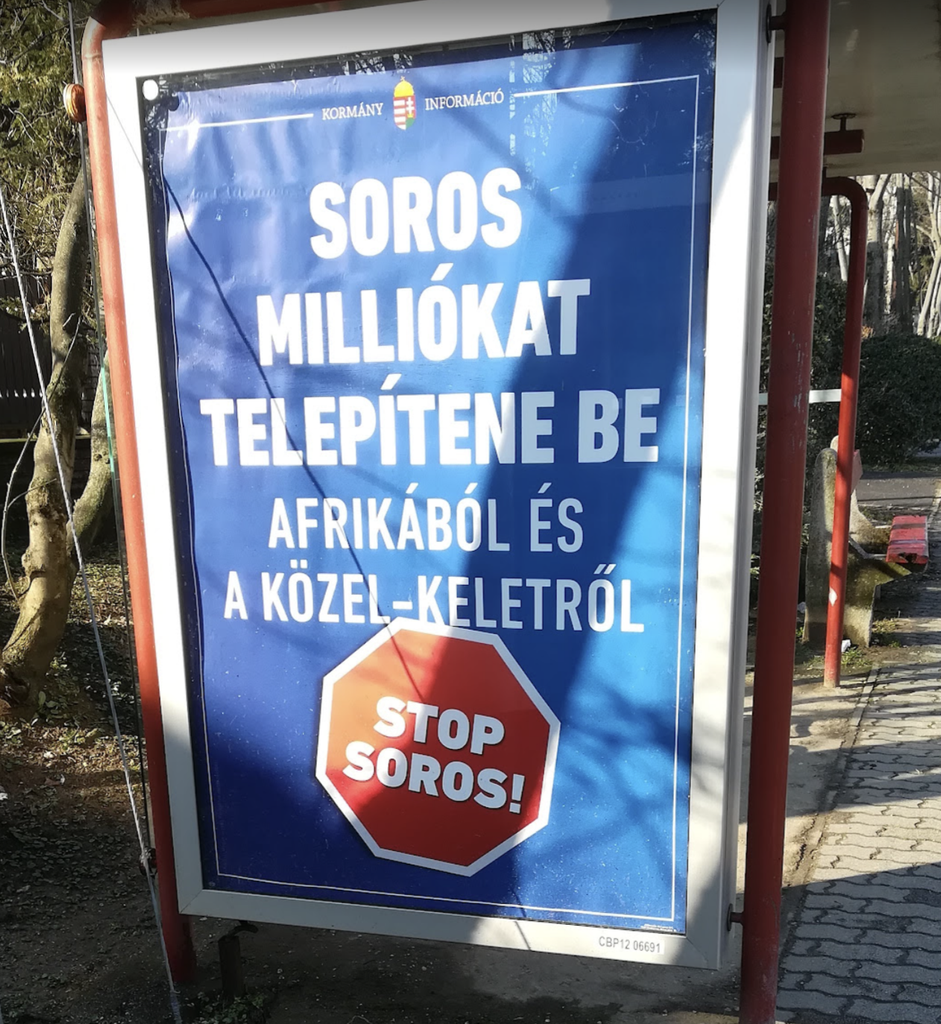
It was easy! Fidesz and their friends had taken control of most media, controlling all of the TVs (which means all of the old people), radio, most press and many internet outlets. Constantly, there were propaganda posters paid by the government or by think tanks, foundations etc..
A friend saw a small kid crying at the playground because he was afraid of the migrants.
2018-2022: cracks appear
The government kept playing the “bad EU card”, and the “Gyurcsány is the opposition” for years.
Ironically, the EU did nothing against Fidesz in all this time3. They made some noise every time the government slipped a bit more but the EPP cherished those sweet EMP votes from Fidesz, until 2021.
The rest of the Europe did just as bad as the EU institutions. German companies kept opening factories and offices in Hungary. Budapest tourism was booming. UEFA was very happy with the new stadiums4 and keeps assigning finals to play there.
2018 had the highest turn out at elections since 2006 (~70%), showing that people were at least making an attempt to change the government. But still, Fidesz won 49% of the popular vote, and 67% of the seats.
In 2020, bam, we got COVID and “emergency measures”. The government gave himself even more power, and never gave it up again.
It is during this mandate that Orbán switched more prominently to the talking point of the “gen z right“: alignment with Russia, extreme opposition to LGBTQ rights (which had not been a major issue previously), stigmatization of NGOs as “foreign agents” etc..
At this point in time there were pretty large protest by teachers asking for a better salary. For me, an Italian, the idea that there are not enough teachers in Hungary was striking, in my home country people wait for years to become one. The main reason is, of course, that Hungarian teachers are wildly underpaid and can barely survive on their salary in big cities.
With post-covid inflation pushing prices wildly up (double digit inflation for years), and with real estate prices ballooning, people started to feel the pressure of a decade of wasted resources: Hungary had fallen from being one of the richest countries in the region to one of the poorest.
The opposition finally managed to get their shit together, and they ran as a single union of all opposing parties5 , with primaries to choose candidates and leadership, and fielding a somewhat independent candidate who had previously beaten Fidesz in some local elections.
This gave some hope to people, especially because the same playbook worked to win the Budapest Mayoral/Council election in 2019.
But this time it didn’t. Fidesz got 49% of the votes and most of the parliament seats, again. Personally, I believe the candidate, Péter Márki-Zay, had the charisma of a bathtub duck (which makes you think about what the opposition primaries were like), but you can think what you want of the cause for the loss.
2022-2024: people get fed up
In 2023, the government passed the so called “revenge law“, a law that worsened working conditions for teachers, with no apparent benefit to anyone. This was vastly interpreted as a form of punishment for lèse-majesté.
Among other things, still relying on the emergency powers coming from 2020, the law restricted the ability of teachers to go on a strike unless they could guarantee that classes were held, nullifying the meaning of a strike.
The EU and some european partners had finally awaken to the fact that Hungary was a pain in the neck, but it was impossible to act against it because Poland, ruled by another right-wing coalition, would block any significant move. After a long time, it started to freeze EU funds. Very little, very late.
Russia’s invasion of Ukraine gave the government more propaganda ammo: the West was obviously interested in war, while Hungary stood alone on the side of peace and compromise.
This new narrative worked on some people who really feared war at their door, but many older Hungarians (the cornerstone of Fidesz base) still distrust Russia for obvious historical reasons so the propaganda was less successful then previous ones.
This leads us to the events of 2024 and then 2026. But I realize this post is far too long, and it’s been in draft for months, and I will post it now, and there will be a follow up.
If I remembered anything wrongly, please correct me, and see you soon.
- I had a front row on the protests as I was living downtown. The protests lasted a long time but with minimal damage to people or things, I’ve seen worse at football games. ↩︎
- It will always be hilarious that one of the scarecrows of Fidesz was Soros, who’s actually Hungarian, and who financed a scholarship for Viktor Orbán in the ’90s to study in the UK. ↩︎
- Remember the ironic “here comes the dictator” remark from Juncker? That’s basically it. ↩︎
- It is a recurring meme in hungarian political discussion that the government spent way more money on football stadiums than it did in healthcare and education. ↩︎
- Technically, there was also a far right party, Mi Hazank (“Our Homeland”) which had split from another far right party, Jobbik (“Better” but also “jobb” also means “right” so “More To The Right”, it’s a brilliant name). Ironically, the original Jobbik was further right than Fidesz, but Fidesz’ shift over the years meant they were now the moderate right. ↩︎