I read this book by accident. It was shared on some forum, I thought it was a small pamphlet or something like that. I thought it’d be a few pages.
A day later, I had read the whole 180 pages book, which turned out to be a fantastic history of the people who participated in building the theory and the experiments around Neutrinos.
It’s an easy pop science read, although some bits may require a couple re-reading, but I think what makes it special is the sheer passion that gets through.
I had not read anything by Frank Close before, and I am now eager to get more of his books.
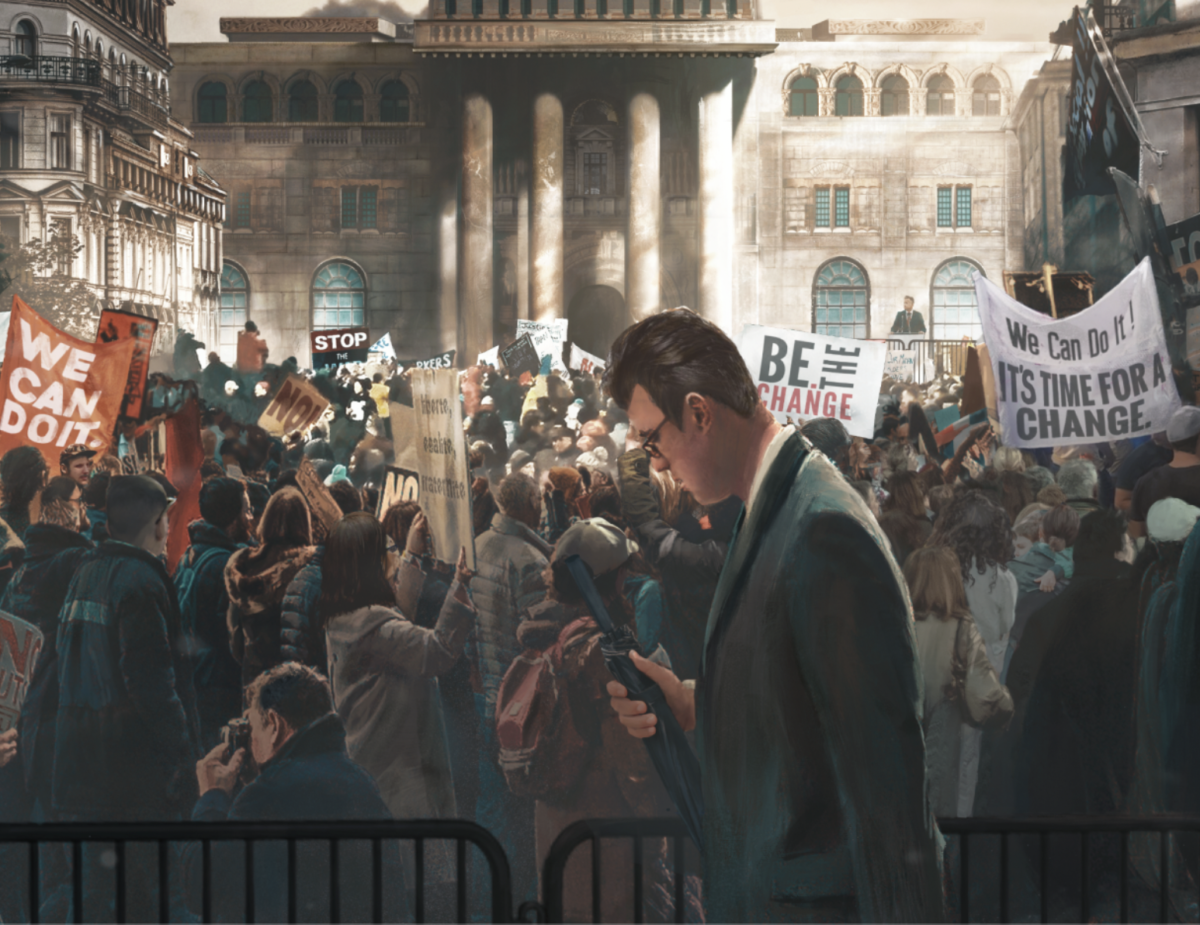
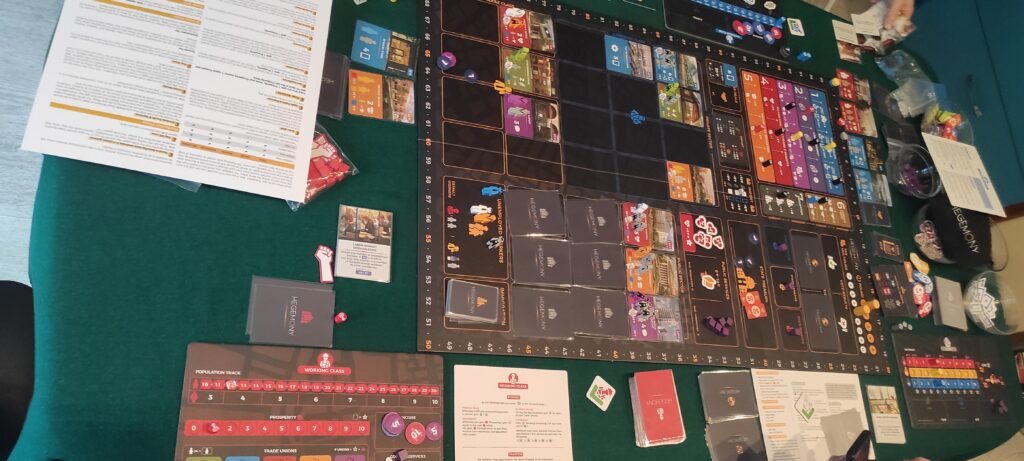
Last week I had the chance to play Hegemony, a game where you take the role of a class amongst Working/Capitalist/Middle, or The State.
Each faction has a different way of playing and get winning points, which can be basically summed up as
Workers get points by getting better Health, Education or Luxury. They can work for Capitalist employers, Middle class ones or State managed ones (and in special cases, workers-run cooperatives). They can also go on strike to ask for better salaries, or do demonstrations if unemployment is too high.
Capitalists get points by gaining money. They can open new companies, do business deals, and trade on the foreign market. They decide the salaries (down to minimum wage) and can improve productivity via automation. They can also choose to just shut down factories if the business environment is not favorable (e.g. taxes and salaries too high).
The Middle class acts as basically both Workers and Capitalists, they can work as employees and can hire a limited number of working class employees, but they don’t have fully automated factories.
the State gets points by gaining legitimacy with all the other classes, which you can do in multiple ways e.g. by providing business incentives or cheap Healthcare. They also manage state-run companies, and need to run on a balanced budget, if the public debt gets out of control the IMF will step in and impose a Washington consensus agenda of free market, low tariffs and less privatized companies. The state also needs to deal with events and particular requests, and try to reach some specific policy goals.
In addition to this, all factions get to play with the regulatory framework. There are 7 policies, the first five are
Fiscal Policy: the size of the public sector (i.e. how many state run companies exist), and how much the government can get in debt.
Labor Market: this is basically the minimum wage: each company has 3 levels of salaries, and this determines if an employer can choose high, high+medium, or high+medium+low.
Taxation: determines the company and income tax. This also affects a “tax multiplier” which only affects companies, which is in turn based on Health/Education.
Health: how much the state should charge for healthcare. Lowering this automatically increases the tax multiplier (i.e. to keep the books balanced, if the state pays for healthcare someone has to pay more taxes).
Education: how much the state should charge for education. Again, lowering this means the money has to come from somewhere else.
These five policies exist on a simplified Socialism to Neoliberalism axis. Two other policies exist on the Nationalism to Globalism axis:
Foreign trade: tariffs on importing goods
Immigration: whether/how many new workers/middle class people get added to the employment pool.
All factions can propose legislation, and get to vote on it. Of course, the bigger you are (e.g. more people in the working class) the more votes you have, but the the elections are done drawing faction cubes from a bag, so there’s a big of randomness (think: parliament). But then, you can also obtain influence by e.g. buying it from the state (think: state TV channels) or doing specific things (e.g. demonstrations) and alter the outcome of the initial draw.
The whole game is thematically very coherent, and “realistic” situation arise naturally, for example
the State offers cheap and abundant healthcare, taxes are high and wages are high
.. privately run companies become unprofitable and lobby for changes to regulation, but fail
.. private Healthcare and Taxes go out of business and private employers refocus on Luxury
Or
Worker class lobby for lower tariffs so they can get cheap goods from abroad
.. but this makes private companies unprofitable, so they shut down
.. the state runs a deficit because there are less companies paying taxes, less money from tariffs, less employed workers but the same expenses
.. state tries to change policy but fails
.. the state goes bankrupt and IMF sweeps in
We also saw a weird case of “financialization” of our Capitalist faction, where it was more convenient for them to buy and sell good on the foreign market than actually producing them and selling them locally, which as an Italian felt very familiar. Fuck Exor.
The game is really good, and playing is quite straightforward, each hand is quite quick. It is also quite player driven, in the sense that each player can ally with another to affect specific policy changes, in a variable geometry which is not always obvious.
The only big problem is that a complete game takes multiple hours. I am sure this gets better with practice, but I can’t see a game taking less than 3 hours (the box says 2-3, but they’re low balling it).
When I was in University I had a few good teachers, and I remember fondly Professor Lorenzo Farina.
Once, he§ came to class and ranted a bit about some job advertisement he had read: the job was for a software engineer, and mentioned they were looking for someone with a smanettone mindset.
Smanettone is an Italian term which in context meant something like “hacker” (in the Jargon File sense) or “tinkerer“. Back then, it was a bit of a shibboleth for people who were into cyber culture, *nix, FLOSS, security and so on. Those of us in the audience who were into that felt immediately positive about the company who had used this.§
Our teacher didn’t know that, so he interpreted it in a negative sense: who the heck are these people looking for? Someone who’ll turn knobs and flip switches without any sort of understanding of what’s going on? That is the opposite of what the engineer mindset should be!
The Tinkerer Mindset
Since the teacher welcomed feedback, we approached him to change his mind at the end of the lesson: that’s not what this is about! Being a a smanettone is about the joy of playing with something, push it beyond what it is designed for, and actually trying to understand it better. It’s about having fun while you build something because of your knowledge, not for lack of it!
There is a definition in the Treccani dictionary now, which roughly translates to
In computer jargon, someone who’s passionate and has fun experimenting, creating and changing the contents of their computer or of the software installed on it.
Vocabolario on line Treccani
It’s an ok definition! It’s not the one I’d write, but it’s close to what I think of as the tinkerer mindset.
(In praise of my teacher, he updated his world view, and I seem to remember he started using the term himself later on.)
The Engineer Mindset
So, I liked to think of myself as a smanettone. But I also like to think of myself as an engineer. I don’t think the two things are at odds.
I think the engineer mindset is about having a method. It does not actually matter what method exactly, but you should act with a plan.
Which is another factor: your actions should be intentional, you do X because you expect Y, not because you have no idea. When you get (or don’t get) a result, you try to understand why.
And you should be able to work logically. Logic is not all one needs in life or on a job, but it is a defining part of an engineering approach to problem solving and solution design.
The engineering mindset and the tinkerer mindset may overlap, but are separated and independent and not mutually exclusive.
I hate ChatGPT
ChatGPT and its ilk are incredible things. If someone had told me a few years back that we’d be able to have quasi-conversations with a bot I’d not believe it§.
But I hate the feeling of working with it, and I despise the concept of prompt engineering.
Prompt engineering is, to put it bluntly, not engineering. It is, at best, prompt tinkering, as it shares exploratory and fiddling aspects.
But it’s actually worse than that, because people do not have actual insights on what is happening, nor do they gain them by fiddling.
You hear stuff like “you should talk directly to the LLM” or “you should talk kindly and say please” or “you should ask to explain itself, and sometimes it works better“. In the OpenAI forums you’ll see people telling each other “oh yeah that works terribly with GPT3.5 try GPT4” but also the opposite.
There is actual engineering going on on top of LLMs. Stuff like RAG or HyDE or ReAct is cool and smart, and you can certainly build things of value on top of these things.
But a large part of it is prompt fiddling. You can’t even know how different LLMs (or versions of the same LLM) will react until you try them out, and when you do, you only know if something worked for whatever input you used, but you have no knowledge of how it will generalize. Sometimes a single different word may cause drastically different outcomes, for no discernible reasons.
You don’t even know if the same LLM will continue to work the same over time! They may be getting dumber while you use them!
Prompt fiddling can be fun, and may work at times, but it’s also deeply frustrating and inefficient.
Shamans and Medics
I once listened to a mythology class, which explained that in many mythologies people or animals are born out of a deity’s armpit.§
The explanation given was that, well, primitive people did not really understand procreation. An armpit is angular, hairy and humid. So, not that much different from female genitalia, right? If one thing gives birth, why not the other?
People did not understand things, they told each other vague explanations and did things that seemed to make sense to them.
There’s a beautiful story of an Arab doctor called to help a Frankish knight. The knight had an abscess to a leg, and the Arab doctor, armed with Greek medicinal theory, wanted to administer him some balm.
But a Frankish doctor came and suggested to chop his leg, “better to live with one leg than die with both!”. Of course the knight died.
Those Frankish idiots! They should have stuck with real science and a proper doctor: it would have been enough to rebalance his humors, and the knight would have been just fine. Or not.
The Frankish medics were not idiots, and they are more or less the reason surgerybecame the real thing in Europe. And the Arab doctors were not idiots either, they had centuries old theories, and sometimes their remedies worked, too.
But they didn’t actually have a proper understanding, and no way of gaining it, they were limited to vague explanations and things that sometimes worked, and sometimes killed people.
And I have the feeling this is where we’re at right now with LLM usage.
One day I wanted to keep the kids (6 and 8) busy, I suggested we play a game, I made up the rules and we used playing cards as the source of randomness. Thus was born PlayingCards-RPG.
Growing up in a town in Italy in the ’80s, I never got the chance to play tabletop RPGs. There might have been people who played them, but I was an introverted kid, a nerd without a like-minded community, so I never got the chance.
This means I don’t actually know how tabletop RPGs work. I have skimmed a couple rulebooks, and D&D’s rulebook clarified that roleplaying is about storytelling and make-believe.
Those, I know.
Character building
Kids are naturally apt at making up characters (more than their parents), so they can easily invent a character. But they are also bad at having them balanced.
Some popular RPGs have emphasis on character stats or classes, attributes such as strength, dexterity, agility, intelligence etc.. and all those are properly codified. But you don’t need that.
In PlCRPG there are 3 stats: Health, and Two Others. The others are Strength/Attack/Defence/Whatever and Intelligence/Dexterity/Agility/Magic/Whatever.
The goal is not to be realistic, is to have something where you, as the adult master can just balance them out. Examples we played:
Black Skull, the tiny alienwith laser eyes: low Health, very high Attack, low defense, can fly.
Vanilla, the Elven Mom: average Health, average Intelligence, average Health, has an invisibility cloak.
Blooddrop, the saber-toothed mouse: low Health, low Strength, high Speed, starts owning some potions.
Almei, the werewolf cub with fractal fangs: average Health, average Strength (it’s a cub), low Intelligence, attack-only bonus.
Luna, the forest girl: average Health, low Strength, average Intelligence, but talks to animals and travels with a pet rabbit.
Grunt, half-orc: average Health, high Strength, low Intelligence.
Fire Spirit: low Health
Can I do something?
I think these are called checks in D&D. You should use a variety of dice with different probabilities but we just had playing cards. Most Italian playing cards use the latin 4 suits (Clubs, Swords, Coins and Cups, these are pretty well suited thematically!) and have 10 cards each. You can use the French or German ones (or tarots, or UNO cards or whatever) sticking with the 1-10 cards, and re-use the others as characters or equipment.
The system is simple: average stats means you use 1-10 cards. High stats mean you use 6-10, low stats use 1-5, buffs through objects or spells change the set of cards.
Some examples:
The party wants to break a door: that requires a 5, the kid player pulls a card, and if it’s above that they manage to break it.
the Half-Orc has 6-10 for Strength, will always succeed
the Elven Mom has 1-10 so she’ll succeed half the time
the Saber-toothed mouse has 1-5 so it just can’t do it (but could lockpick it)
The party is in a room looking for a book: I think this is a bit harder so I decide it requires a score >6
Elven mom has a 40% chance to pass
…but she found a spell that makes light, so instead of using cards 1-10 she’ll use 3-10
Werewolf cub is dumb, so even with the light he can’t do it
Fights and stuff
Fighting happens card-on-card: you attack with what you draw, defend with what you draw, subtract the difference from remaining health. Each player attacks in turn, the master makes up the order . To deal with extreme disparity, a “best” draw still does something.
For example Half-Orc fight a fire spirit:
Half-Orc has High Strength (cards 6-10), random Fire Spirit is tiny (cards 1-5). Half-Orc draws a 8, fire spirit draws a 4, takes 4 damage.
Fire Spirit attacks the Half-Orc, draws a 5: it could never damage the other which will always get a draw >6, but to make this mildly interesting a 5 (best draw) sets the other on fire, so they lose 1 health every round.
Experience, levels and such stuff
I did not bother with this. The kids will pick new characters the next game, and if they want to keep the same and “get better” I’ll just let them find some equipment.
Exploration, maps and such
I just draw on a bit of paper, I pre-planned dungeons but sometimes I just add stuff as we go on. My kids can’t be bothered to count steps and such, so I just have them move from one place to another instantaneously, it works well enough.
Conclusion
This is not a lot of rules. It’s barely more than not having rules, but the point is to get creative while spending time with your family, which we all enjoyed. There will be plenty of time to play with big rulesets when they grow up (and then there won’t be, as they’ll think playing with Dad is lame).
But do let me know if you have your own made up game, I’d be happy to play that too 🙂
I like Neil Gaiman quite a bit, but this book felt somewhat different: it felt somehow like a Stephen King story.
Mild spoilers ahead.
The book is written as the main character, as an adult, visits the place where he grew up. There’s a pond there, but he knew, as a kid, that it was no pond, it was the ocean. And there was a girl, somewhat special. And a man, who killed himself.
See? Isn’t this your Kingesque coming-of-age/did-we-imagine-it-or-was-it-real plot?
It also feels pretty intimate, you are led to immediately visualize young Neil in the story, not a random kid. It’s a good book, well written, with a good story and characters.
And a big difference between King and Gaiman is that Stephen is not very good at endings, but Neil is great.
I am not sure how I got into these audiobooks, but I think it’s because the premise was pretty great: Bob is a software developer that gets his mind uploaded into a Von Neumann probe, a spacecraft that travels the universe replicating itself.
This poses a few interesting issues: how does such a human survive as disincorporated mind? How does he deal with the solitude of space? How does it deal with clones that have his exact thought process?
It also creates interesting issues for the writer: how do you write about traveling through the endless vacuum in an interesting way? How do you create contrast between copies of the same character? And if Bob is now just software, when it gets copied to another machine, is it the same?
Hic Sunt Spoilers
Well, the plot issues are handled easily: you Marty Sue the shit out of them. Bob builds its own virtual reality. Its own AIs. Its own faster than light communication and drives. He masters computer science, material science, physics, biology, agronomy, astronomy. He terraforms, creates life, alters solar systems.
Most problems boil down to being barely an inconvenience, except for the issue most males have struggled during the ages: getting the girl. Women, uh?
(This is ironic, don’t lynch me please)
The writing issues are often sidestepped: there is no void of space, Bob just never gets bored or just sleeps. There are never N copies of the same character, since there is always some drift. You can’t copy a Bob.
I liked the idea that you can never have two copies of the same personality (because “quantum“), but if you turn one off, then you can move it to another machine.
It’s a good enough solution for the well known issue that the teleportation is incompatibile with a unique soul, which I expect will be tackled by some futureinterstellar council (I hope the ensuing schismatics/heretics will be called Renziani, whatever their position).
Anyway, the books are entertaining, Bob acts as God to some creatures, screws up some stuff, fights battle, kills aliens, deals with conspiracies. The various incarnations of Bob are likeable, no doubt due to a good performance on part of the narrator.
There’s also a certain amount of “here’s a new chapter and a new issue, and here’s how I tackle with my smarts” which can either get on your nerves or entice you depending on how much you identify with the character.
The author winks a lot to a certain reader, filling the book with nerd references which can be nice, but it gets boring after a while. Not as bad as Ready Player One anyway.
My ending is better
I liked the fourth book the most. The Bobs go looking for a lost Bob and find a giant space structure where an alien civilization is kept in a permanent state of low-tech development. Not wanting for anything, but stagnating, ignorant of their status, and slowly devolving.
Here the Bobs go on an adventure and find a giant computer mind that manages the whole civilization for their own good. Having incarnated into robots, the Bobs travel the planet, meet people, do stuff, start revolutions and so on.
This is my favorite book as the author seems to have abandoned the somewhat gimmicky nature of the first three, and gives us a cool space adventure, interesting world building, characters with mode depth. I think it might have made a good standalone book even leaving the Bobiverse aside completely.
My only disappointment is that I really, really, really wanted the evil computer mind to be the lost Bob. This would have cast a shadow on previous choices the Bobs did, forcing the reader to face hard ethical choices. Alas, we just get a “everybody is happy” ending.
Still, it’s nice to have happy endings now and then, and I look forward to the next book.
Last summer I spent some time in Campania, and my family took the chance to visit a few places we had not seen before.
My wife had visited it, but I had never been to the Reggia di Caserta, the largest (former) royal residence in the world, which you may remember as being the background for the royal palace in Star Wars: Episode I.
Charles VII of Naples wanted to build a big palace to make it the administrative center of his kingdom. But history is what happens while you’re making other plans, and by the time the palace was finished, Italy’s unification was underway, and the center of the state would move to Rome.
It is, anyway, a stunning sight, and I highly recommend it. But I did not want to talk about this in particular.
Lost and found and lost again
We visited the archeological site of Pompeii, a populous Roman city which was thriving in the first century. Alas, history had other ideas.
The eruption of mount Vesuvius covered the city in volcanic ash, and also destroyed the nearby Herculaneum§.
We know a lot about this, because Pliny the Younger saw the thing with his own eyes, and wrote about it. After the disaster there was some feeble attempt to recover some stuff, and there was some looting, and the Romans gave up on excavating meters and meters of ash, and over the centuries we forgot where the city was.
I can hear you, Dear Reader, “How do you lose a city? Just look at a freaking map!“. But you see, there were not a lot of maps. And the topological references weren’t there either. The coast had shifted by kilometers, and even the layer of ash had been covered by dirt and vegetation.
The city was buried somewhere, but people had no clue, nor interest, in looking for it. Until they did, in the 18th century. First we found Herculaneum by mining stone, and then we found Pompeii, covered by the ash.
We were lucky because the ash preserved a lot of the city, including paintings, mosaics, statues, buildings and more.
If you visit Pompeii you have the surreal feeling of walking in a theme park, because there is just so much stuff. You will see the bakeries, the eateries, the public baths, the tanneries. You will see painting of gods, advertisement, political campaigning. The brothels and the temples and the places of government§.
And of course, you will see the calques of the people, and animals, who died there. You see, before the ashes arrived the people and animals were killed by fumes, and their muscles contracted and kept them in position as the ashes fell over them.
It must have been a terrible way to die§, and the cast of the dog trying to free itself has made an everlasting effect on me when I first saw it as a kid.
And yeah, the casts. When Giuseppe Fiorelli started working on the city in the 19th century, he noticed they were hitting empty cavities left by the (long disappeared) bodies. He had the brilliant idea of using liquid plaster to fill such cavities, and then excavate the casts and look at them.
The plaster casts are incredible, the images of people covering their head, hugging each other, cowering in obvious fear. I am moved a bit even as I write. A write described as
The pain of death that gets back body and image
Luigi Settembrini
The casts are an incredible window on the past, but Fiorelli was not foreseeing enough: we have lost many of them due to bombings in WWII. And he had not accounted for the fact that gypsum will, over time, fall apart on its own. So we have lost many of the casts, and this time it will be forever.
Modern archeology is attempting to use resin for the same process. Resin has a big advantage: you get to see the bones inside. For some reason, I don’t like this, it feel indiscreet to look inside people..
The unseen city
Both me and my wife had seen Pompeii already, and yet neither of us did.
You see, Pompeii has not been fully excavated yet. As far as I understand, it is a bit of a dream for an archeologist to be able to participate in the ongoing excavation. But modern archeology moves slowly to preserve as much as possible§, I may not be alive by the time they are finished.
And even if I was around. I’d likely still not see it all. There is not enough personnel to monitor a site this big, so only parts of the city are accessible every day. One day you may see something, one day you may see something else. And maybe one day we’ll get another bombing, and something will be gone forever.
Something lost for centuries right at our fingertips, and yet impossible to see.
The temples nobody knows
Another place we got to visit was Paestum, which was also a Roman city. Except of course before that it was a Lucanian city. And before that a Greek city, named Poseidonia, after the God of the sea, as it had an enviable position close to it, and was an important commerce center. Alas, this was not to last.
The delta of the nearby river clogged up, this in turn made the river stagnate, and the nearby land become swampy. With swamps came mosquitoes, and with mosquitoes came malaria. The city became a bad place to live, and it slowly depopulated until it was completely abandoned in the middle ages.
And so, once more, we lost a city.
William Stanley Haseltine – Temple of “Ceres” at Paestum, 19th century. Notice the swampiness.
I can hear you Dear Reader, you are thinking: “I’m literally looking at a picture of the temple, we obviously did not lose it!”
Sure, but you have to understand: that’s just a temple. Sure, people who lived in the area may know that there were some ruins there, but they didn’t know what it was, and the collective consciousness had forgotten about it. Some people may encounter the name in ancient texts, and would identify it with the nearby Agropoli.
It’s hard to imagine that some knowledge may just disappear, in an era where you can lookup any random name on the internet, but forgetting was the norm.
The historian Alessandro Barbero often says this about antiquity: when an historian or a teacher speaks about antiquity, we have the feeling of knowing everything about it. In reality, we know almost nothing about it.
Historians in pre-modern times wrote some stuff down, but not much, most was lost, and some time they just made shit up. Someone invented a princess Scota of Egyptian origin to explain the latin name Scotia for Scotland, and this became accepted knowledge for a few centuries.
Charlemagne founded the Scola Palatinae to standardize the bible, gave it money to fund monks, its own herd of sheep to make parchment… and they did a massive production of 2 bibles per year. For centuries knowledge was rare.
But today.. this is such an incredible site, and still, it is kind of forgotten. Did you know about it? I was lucky enough to visit it while in high school, but my wife, who has travelled Italy far more than me, had never even heard of it.
Apparently this place is home to 2 overlapping UNESCO sites. It’s a stunning area where you can see multiple Greek temples intermixed with Roman architecture. There are Lucanian tombs and paintings (these are the folks who invented the -Roman circus, tho you may never had heard of them). The city is also where the largest surviving Greek painting was found.
It’s a must see in my opinion (although the museum is under renovation), and I hope it does not get forgotten.
A city is not dead while its name is still spoken§
I worry sometimes about our age. We have access to so much information that it becomes really, really hard to focus. In a sense, we live in the opposite hell of the medieval people.
Any historical site needs to fight for relevance, or it will be forgotten. People used to travel in their own country before going abroad, but they don’t anymore, so you don’t get “visited by default” these days.
This won’t be a problem for Florence or Stonehenge but what will happen with the minor sites?
And what will happen with non-historical sites? Small towns are already depopulating and being abandoned in Europe and elsewhere. In the last 20 years large urban population doubled, in part because of population growth, and in part because people no longer want to live in a small village with one church (or temple).
There are towns becoming forgotten right now, I suppose this is normal, but it is, in some sense, humbling. We will be forgotten too, and I am sometimes saddened that I can’t remember my grand-grandparents’ names§, and perhaps it is necessary to lose sight of old things to focus on the new ones.
A phrase often heard by Italians visiting Greece is “una faccia una razza“, (one face, one race) implying we look like each other, so we’re more or less the same people.
This sentence may have stemmed from fascist propaganda, but it has been embraced by the tourist industry, because one thing Capitalism is good at is recycling things. Think Che Guevara t-shirts.
And yet, one can forgive the person who made it up, as Italians do feel at home in Greece. When Greeks and Italians meet and discuss the oddities of their respective countries, the other side is generally nodding along saying yeah, we also have this.
Messy government? Check. People spending way too many years in university for no good reasons, and the concept of “refusing low grades”? Check. A bunch of leftists and anarchists§ but also popular neo-fascist movements? Double check. The sea, mediterranean diet, family, religion..? Check them all.
I also believe spoken Greek is the only language which shares a melodic cadence with Italian. If you hear people speaking but you can’t hear the words, you can easily confuse the two§.
This was, perhaps due to the fact that I grew up in Italy, but I think it was really because I got into competitive trivia with my best friend, trying to outdo each other in class with anecdotes and tales and such.
Anyway, in my child brain, Roman, Etruscan, Greeks etc.. all got mixed up together, and that has tinted my perception since, and made me feel like we share more than we may actually do.
Gave me that feeling that, sure, we share no language nor alphabet, but modern Greeks and modern Italians have a common inheritance. Deep down, while our respective countries are no longer the center of the universe, we still look at the rest of the world and somehow still feel we’re the civilized ones, and foreigners are barbarians.
In the words of the satyrical masterpiece Fascists on Mars, one can secretly keep thinking of outsiders as
people who were hunting groundhogs naked, while we were already stabbing a Julius Caesar!
Gaetano Maria Barbagli (Corrado Guzzanti)
Is this feeling justified? Of course not, Dear Reader, it is pretty obvious we are the backward countries now. But still.
A tale of two cities
So when arriving in Athens, I expect to see Rome. Old women going to churches, with a slightly different layout. Collapsed temples, albeit made from different stones. Roads that were old millennia ago, covered with cars that should have been kicked out of the city center decades ago. Shitty souvenir shops and grand architecture.
That is true, up to a point. But what I did not realize is that Athens and Rome diverged, in the last couple millennia, while I wasn’t paying attention.
Rome was still an important center of the western mediterranean, while the eastern center moved to CostantinopoleBysantium Istanbul.
While Rome was the see of the Pope and capital of the Papal States, Athens was a minor city in the Ottoman Empire. Rome got new baroque churches, while the old ones in Athens were converted to mosques, and when the greeks gained independence, they were, supposedly, demolished altogether.
That would explain why you don’t find something like San Paolo fuori le mura, but either large modern churches, or tiny ancient ones, that the ottomans didn’t bother with.
And then you have the modern developments. Downtown Rome has been a mass tourist destination for decades, and this means almost everything downtown has been restored and redone to accomodate tourists. Except public transport. Meanwhile, downtown Athens is still full of half-demolished buildings, and a stone throw from the tourist center you’ll find big ugly buildings where floors have been converted to be a Chinese import warehouse. Chinese Communism is good at recycling things, think Che-Guevara t-shirts.
So the city feels, in some sense, still protected from mass tourism. Yes once you climb up the acropolis you will encounter a bunch of pesky foreigners, but you still have a chance of meeting some genuine greek people downtown.
What is also interesting is that, as soon as you walk a bit out, you’ll find a bunch of rundown buildings which, you would assume, could be trivially renovated and turned into a B&B. But I am told this does not happen because they appear to often have no foundation.
So you’d have to build one but (like in Rome!) as soon as you dig a hole you’ll find something of archeological value, and the authorities will freeze the construction. And so no bank is giving out loans for this, and so it does not happen. Fintech is not good at recycling things.
A big hunk of stone
What might really set Athens apart from Rome, is the fact that it’s a port. I mean, the sea is a pretty distinctive thing. But you see, Athens is not named Poseidons.
A legend§ goes that the God of the Sea and the Goddess of Wisdom had a contest to decide who would be patron of the city, on the Acropolis.
Poseidon struck the ground and water sprung out. Athena had an olive tree come out of the dirt. The people chose olives.§
But the main character in this story is neither Athena nor Poseidon. It’s the Acropolis.
I did not expect the Acropolis. Rome has hills, sure. Edinburg has a pretty massive rock in the middle. Many ancient cities are built on high ground.
But the Acropolis of Athens dominates the city with an almost cyberpunk look.
Its sides have been built and rebuilt and fortified and bombarded and it has almost no vegetation, and you just look up and you see it from freaking everywhere.
Basically every accommodation in Athens has “a view on the Acropolis” in their description because it’s visible from everywhere, it’s just a matter of turning the right way!
And… it’s somewhat tiny at the top? But oh, so beautiful.
I am familiar with classical temples. I’ve seen a ton of them, both Roman and Greek. A church in my hometown has columns that have probably been stolen from some and I grew up between them.
I know, cause I studied it in school, that columns are tapered to trick your eyes to look taller. I remember the ones on the corners are bent differently to make the facade look better. I recognize the column orders. And yet, the Parthenon is such a sight that your rational brain takes a back seat and you’re left in awe.
Shadow of the Colossus
The problem with the Acropolis, and the Parthenon, is that it’s too important. The newly built Acropolis museum is literally shaped like the rock, and it was built to host the Parthenon marbles when the freaking barbarians will give them back.
But there’s so much more! For example, the Kerameikos area is absolutely awesome, but mostly ignored by weekend travelers. As someone who has shepherded people in Rome, I can sympathize, I know I’ll never get anyone to stay long enough to visit everything, they just want to put a checkmark on the Colosseum and Saint Peter.§
What about modern Athens and ancient Athens tho? Are people condemned to live in the shadow of ancient greatness, will they be constrained by that? Should modern artists measure themselves with Phidias?
I don’t think so. And I don’t think it’s happening. Athens felt like a vibrant city, where many things are happening.
But perhaps it is at risk, as mass tourism inevitably embraces it. Like Rome, its center will probably become even more overrun with shitty accommodations and pseudogreek eateries. Old people will die and their kids will rent out their places. New buildings will come and old ones will go. You’ll no longer walk on cracked stairs built a century ago, but on modern ones made with marble imported from the Far East. The soul of the city will shift.
But there’s something called the Lindy effect, which in short says, the older something is, the more likely it is it continue existing.
Do you trust the building you’re in now, to be there in 50 years? 100 years? 200? I do not. But I’m pretty confident the Etruscan tombs in my home town will still be there.
Athens will be fine too, it went through a lot, but it stood for three millennia, it’ll manage.
This is a book published in 2020, and I decided to read it as it’s quite short, it has been recommended a few times in many forums, and let’s be honest, it has a pretty fantastic title.
The book is credited as being written by T. Kingfisher, but that turns out to be a pseudonym for Ursula Vernon, and is supposedly a young adult publication.
I actually did read something from Ursula before, the Digger comic § and I quite liked it! But it has a completely different vibe.
The book tracks the adventure of a young magicker girl who works in a bakery and specializes in, well, bread magic. It is quite entertaining, light hearted, and I feel a movie might be objectively great.
Of course, I am not the target audience, so to me it seemed perhaps a bit simplistic and predictable, but hey, it was fun.
Last year I readthis comic by Matt Kindt, I put off writing a blog post about it for a long time, but I really wanted to do it, as this is one of the best thing I have ever read.
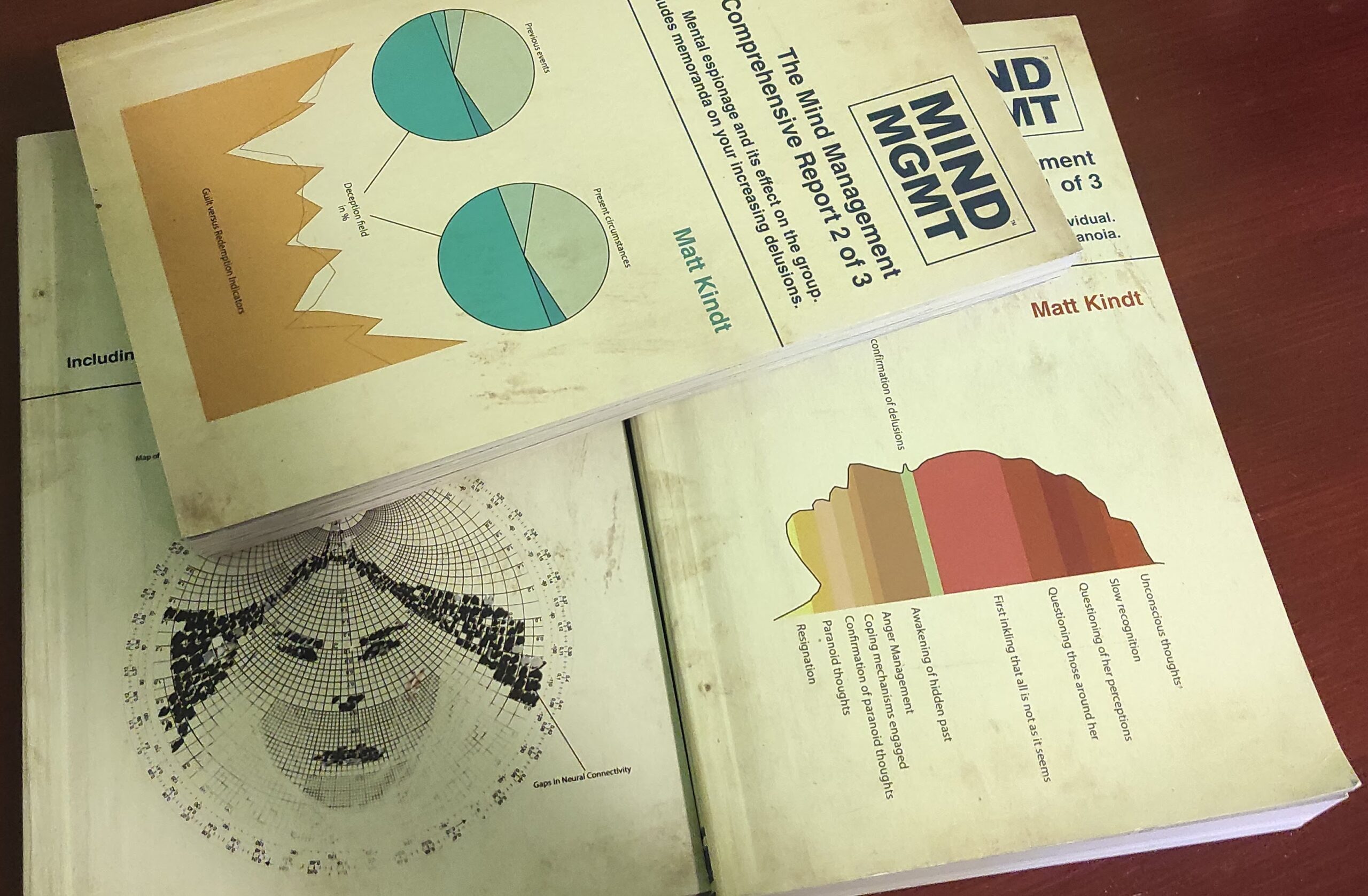
I read the three-volume omnibus, which was pretty complicated to get§but it was worth it.
MIND MGMT Omnibus
The comic book tells the story of an eponymous government agency which specializes in training and handling agents with psychic powers, sending them to operate all over the world as you would expect from any proper spy agency.
Common classes here are subliminal messages in advertisement, mass hypnosis via books and music, predicting the future, and becoming immortal. And there are monks in charge of recording the actual history of the world, to keep the agency honest.
Most of all, these are not super-heroes with super-problems with larger than life fighting scenes. These are problematic government officers working in a paranoid spy world reminiscent of the cold war, while also having god-like powers, with conspiracy theories thrown in.
The story is about a woman, Meru, who ends up discovering the existence of MIND MGMT, meeting some of its members, learning about herself, and showing by example why the agency is either a terrible evil or an absolute necessity.
But this is not what the book is about. The essence of the book is to give depth and concreteness to this world, which it does in every possible way. The pages are printed as field report forms, including dotted lines and “please write here” notes. On the page borders, you find excerpts of the MIND MGMT Field Guide, in-universe novels, songs, poetry, fourth-wall breaking messages from the characters, and so on. Also, we get “personnel files” in each number, which are small masterpieces on their own.
The faux advertisement interspersed in the book will regularly contain hidden content, in-panel text is always meaningful, and while most of this is obvious you will get stuck trying to extract information from everything.§ If a book makes you paranoid, it means it’s good.
The art style is somewhat off-putting at first but improves as the books go on, and at some point it becomes implicit communication itself, which is pretty great.
The story gets meandering about 2/3 of the way, and IMO it could have been shorter and little would have been lost, but this is saved by one of the best ending I read in my life.
I regret not having read this at the time it was being published, not knowing it existed, but this comic is so good I ended up also buying a four-issue spin ogg mini series recently published, MIND MGMT: Bootleg§ and heck, I almost bought the board game too.